

Why Prioritize American Dog Products for Your Pet
American-made dog products are defined by the FTC as goods where all or virtually all components and processing occur domestically, a standard that directly translates to safer, more traceable products for your dog. 53% of U.S. households own a dog, and premium pet food purchases rose 5% in 2024 alone. That spending shift reflects something real: dog owners increasingly recognize that where a product is made determines what goes into it, how it’s regulated, and whether it can be trusted. The reasons to prioritize American dog products go beyond patriotism. They come down to FDA oversight, ingredient integrity, supply chain accountability, and the economic health of your community.
Why prioritize American dog products: the regulatory case
The single strongest argument for choosing American-made dog supplies is regulatory oversight. Domestic manufacturers fall under FDA post-market enforcement and FTC regulations that reduce contamination and mislabeling risks compared to imports. That means when something goes wrong, there is a traceable chain of accountability. With imported products, that chain often breaks at the border.
The FDA’s Food Safety Modernization Act (FSMA) requires domestic pet food manufacturers to follow strict sanitation protocols, maintain hazard analysis plans, and submit to facility inspections. No equivalent requirement applies to foreign manufacturers exporting into the U.S. unless they register with the FDA, and enforcement of that registration is inconsistent at best.
The 2007 melamine contamination crisis is the clearest example of what happens when oversight fails. Melamine, an industrial chemical, was added to Chinese-manufactured pet food ingredients to artificially inflate protein readings. Thousands of dogs and cats died. The contamination traced back to a supply chain with no domestic regulatory touchpoint. American manufacturers operating under FSMA would have faced mandatory recall procedures and facility shutdowns at the first sign of contamination.
“FDA does not pre-approve most pet foods. Proactively choosing transparent American brands reduces risk before a problem ever reaches your dog’s bowl.” — americanmanufacturing.org
Rawhide is another live example. FDA rawhide safety advisories triggered a 400% surge in inquiries for traceable dog chews by May 2026. That surge happened because owners realized most conventional rawhide is processed overseas with bleaching agents and chemical preservatives that no U.S. agency directly monitors.
Pro Tip: When evaluating any dog food or treat, search the FDA’s recall database by brand name before buying. American brands with clean recall histories are easy to verify. Imported brands often are not.
Key regulatory advantages of American-made dog products include:
- FDA FSMA compliance requiring hazard analysis and sanitation controls
- FTC oversight preventing false “Made in USA” labeling claims
- Consumer Product Safety Commission standards for toys and accessories
- Mandatory recall systems with traceable batch numbers
- Domestic facility inspection requirements with enforcement teeth
American-made vs. imported dog products: a direct comparison
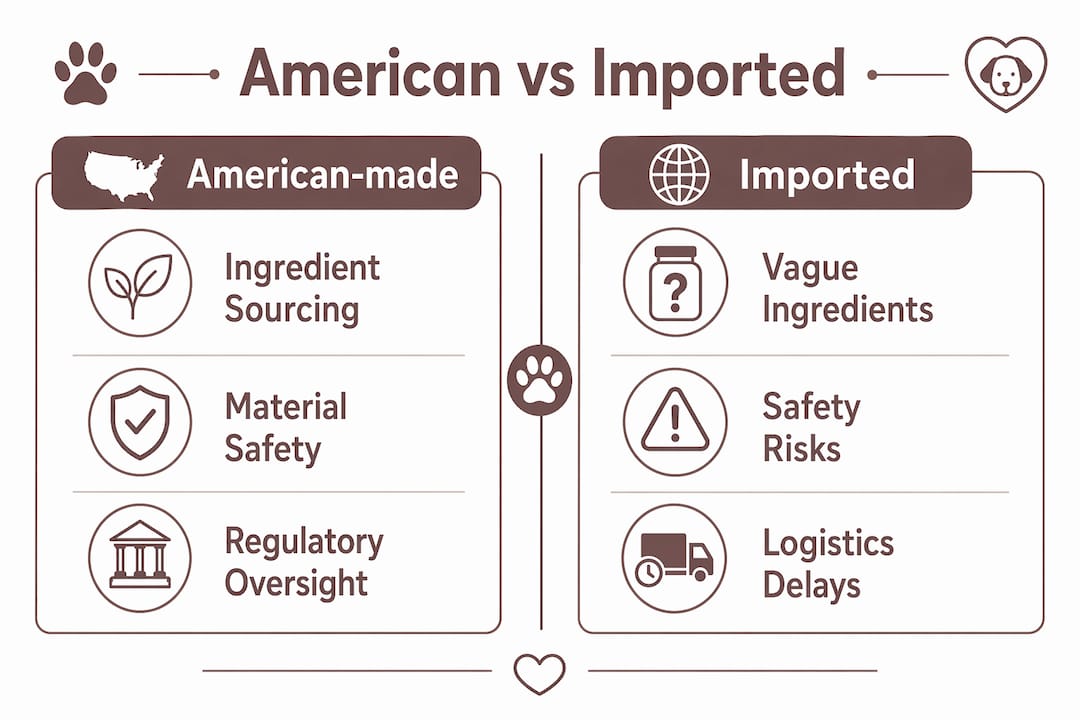
The differences between domestic and imported dog products show up in four areas: ingredient sourcing, material safety, supply chain transparency, and long-term value.
| Category | American-made products | Imported products |
|---|---|---|
| Ingredient sourcing | Named proteins, domestic farms, verifiable origins | Vague descriptors, multi-country sourcing, limited traceability |
| Material safety | BPA-free, phthalate-free certifications published | Safety data rarely disclosed; harmful additives documented in recalls |
| Supply chain | Short, domestic, auditable | Long, multi-country, difficult to audit |
| Regulatory accountability | FDA, FTC, CPSC oversight with recall systems | Inconsistent enforcement; recall coordination often delayed |
| Price point | Higher upfront cost | Lower upfront cost, higher risk of replacement or vet bills |
American chew toys often come with published material data sheets confirming the absence of BPA, phthalates, and latex. That level of disclosure is rare in imported alternatives. For a dog that chews aggressively, the difference between a certified-safe toy and one with undisclosed chemical additives is not abstract. It shows up in your vet’s office.
Domestic products also reduce complexities like customs delays, multi-country logistics, and verification barriers that make it nearly impossible for consumers to confirm what they are actually buying. When you purchase a treat made and sourced in the U.S., the supply chain has two or three steps. An imported treat may pass through five countries before reaching your dog.
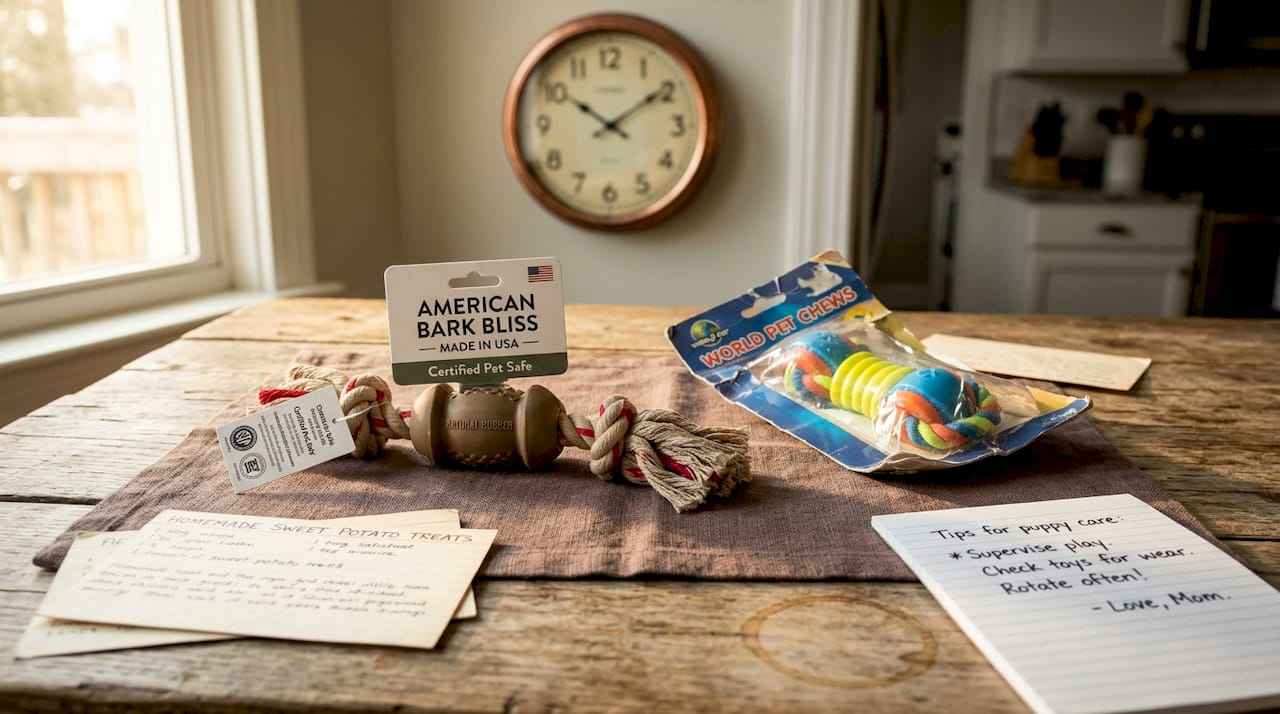
Pro Tip: Check whether a brand publishes a Certificate of Analysis (COA) for its products. American manufacturers that do this are giving you lab-verified proof of what is in the product. If a brand cannot produce one, treat that as a red flag.
The value argument for American-made products is also stronger than it first appears. A premium dog bed made with domestic materials and construction standards typically outlasts a cheaper imported version by years. The upfront cost difference often disappears within 18 months when you factor in replacement frequency.
Economic and community benefits of buying American dog products
Choosing American-made dog supplies does more than protect your pet. It directs spending toward domestic manufacturing jobs, small business owners, and local supply chains that strengthen the broader economy.
82% of pet owners view their dogs as family members, and 60% of millennials and Gen Z cut their own discretionary spending before reducing pet spending. That level of financial commitment means pet owners wield real purchasing power. Directing that power toward American brands creates a measurable ripple effect through local economies.
The environmental case is equally concrete. Domestic manufacturing eliminates transoceanic shipping, which cuts transportation emissions significantly. A dog treat made in Kansas and shipped to a buyer in Texas travels a fraction of the distance of one manufactured in Southeast Asia. Lower shipping distances mean a smaller carbon footprint per product, which matters if you care about sustainable dog products and the world your dog lives in.
The economic benefits of prioritizing American dog products include:
- Direct support for U.S. manufacturing jobs and domestic suppliers
- Reduced dependence on overseas supply chains exposed by recent global disruptions
- Lower transportation emissions from shorter domestic shipping routes
- Support for small businesses that operate under higher labor and welfare standards
- Contribution to a “buy local” economy that keeps money circulating domestically
Recent supply chain disruptions have also exposed the fragility of relying on overseas manufacturing. During global shipping bottlenecks, American brands with domestic supply chains maintained product availability while imported alternatives faced months-long delays. For a dog owner who depends on a specific food or supplement, that reliability is not a minor convenience. It is a health consideration.
How to identify genuinely American-made dog products
Knowing why to buy American matters less if you cannot tell which products actually qualify. The FTC sets a high bar: a legitimate “Made in USA” claim requires all or virtually all of a product’s components and processing to be domestic. Phrases like “assembled in USA,” “designed in USA,” or “distributed by a U.S. company” do not meet that standard.
Here is how to verify claims and select genuinely high-quality American dog products:
- Check the FTC label standard. Look for “Made in USA” specifically. “Assembled in USA” means components may be imported. “Manufactured in USA” can mean the same. Only the full “Made in USA” claim carries FTC weight.
- Read the ingredient list from left to right. Ingredients appear in descending order by weight. The first ingredient should be a named animal protein: chicken, beef, salmon. If it is “meat meal,” “animal by-products,” or a grain, the formula is built around cheap fillers.
- Look for batch numbers and lot codes. American manufacturers that take traceability seriously print batch numbers on packaging. These allow you to cross-reference the FDA recall database and confirm production dates.
- Request or search for a Certificate of Analysis. Reputable American brands publish COAs from third-party labs confirming nutrient content and the absence of contaminants. This is standard practice among premium domestic producers.
- Evaluate toy materials explicitly. For high-quality dog toys, look for brands that publish material safety data. BPA-free and phthalate-free certifications should appear on the product page, not just in marketing copy.
Pro Tip: Search a brand’s name plus “recall” on the FDA website before purchasing. A brand with zero recalls and published COAs is demonstrating accountability, not just claiming it.
Ingredient red flags to avoid include artificial preservatives like BHA, BHT, and ethoxyquin; vague protein sources like “poultry” or “meat”; and artificial colors with no nutritional function. These appear far more often in imported products than in domestic ones, precisely because American manufacturers face regulatory pressure to avoid them.
Key takeaways
American dog products deliver measurable safety, quality, and economic advantages because U.S. manufacturers operate under FDA, FTC, and CPSC oversight that imported alternatives routinely bypass.
| Point | Details |
|---|---|
| Regulatory oversight is the core advantage | FDA and FTC regulations make American-made products safer and more traceable than most imports. |
| FTC labeling requires strict verification | Only “Made in USA” meets the FTC standard; other claims may cover imported components. |
| Material safety is documented | American toy and accessory brands publish BPA-free and phthalate-free certifications that imports rarely provide. |
| Economic impact is real | Buying American supports domestic jobs, reduces emissions, and strengthens local supply chains. |
| Practical verification is possible | Batch numbers, COAs, and FDA recall searches let you confirm quality before buying. |
What I’ve learned from years of watching pet owners choose products
I have watched the pet products market long enough to know that most owners make purchasing decisions based on price and packaging, not on regulatory standing or supply chain depth. That gap between what matters and what gets attention is where dogs get hurt.
The 2007 melamine crisis did not change buying behavior as much as it should have. Owners were horrified, then gradually drifted back to cheaper imported options as prices normalized. The pattern repeats with every recall cycle. What breaks it, in my experience, is not fear. It is education. When owners understand that premium dog products made domestically carry a fundamentally different risk profile than imported alternatives, the purchasing decision changes permanently.
The cost objection is real but often overstated. A $40 American-made toy that lasts two years costs less than two $15 imported toys that fall apart in six months each. The same math applies to food: a dog eating a clean-label domestic diet often has fewer vet visits related to digestive issues, skin problems, and allergies. The savings are not always visible at the register, but they show up over time.
My honest advice: start with one category. Switch your dog’s treats to a verified American brand with a published COA. Watch the difference in your dog’s digestion, coat, and energy over 60 days. That single experiment tends to convert skeptics more effectively than any argument I can make here.
— Christopher
Find trusted American-made dog products at Americanbarkbliss
Americanbarkbliss curates a selection of premium American-made dog products built around the safety and quality standards covered in this article. Every product category on the site prioritizes domestic sourcing, ingredient transparency, and material safety. If you are ready to make the switch, start with the Americana Chicken Chips, a USA-made treat with clean ingredients and zero artificial additives. For play, the tug toys collection features durable, safety-verified options built to last. Browse the full Americanbarkbliss catalog at americanbarkbliss.com and shop with confidence knowing every product reflects a commitment to American craftsmanship and your dog’s health.
FAQ
What does “Made in USA” actually mean for dog products?
The FTC requires that all or virtually all of a product’s components and processing be domestic for a legitimate “Made in USA” claim. Phrases like “assembled in USA” or “designed in USA” do not meet this standard.
Are American dog products safer than imported ones?
American-made dog products operate under FDA and FTC oversight that most imported products bypass, reducing contamination, mislabeling, and unsafe ingredient risks. The 2007 melamine crisis, which killed thousands of pets, originated in an overseas supply chain with no domestic regulatory checkpoint.
Why are American dog products often more expensive?
Domestic manufacturers face higher labor standards, regulatory compliance costs, and quality ingredient requirements that raise production costs. That higher upfront price typically reflects lower long-term risk and greater product durability.
How can I verify a brand’s “Made in USA” claim?
Look for FTC-compliant labeling, published Certificates of Analysis from third-party labs, and batch numbers you can cross-reference with the FDA recall database. Brands that cannot provide these should be treated with caution.
Do American dog products support local economies?
Buying American-made dog supplies directs spending toward domestic manufacturing jobs and local suppliers, reduces reliance on fragile overseas supply chains, and lowers transportation emissions from shorter domestic shipping routes.
Leave a comment