

Adjustable Pet Harness: Safety, Fit, and Comfort Guide
An adjustable pet harness is a multi-point walking accessory that customizes the fit around a dog’s neck, chest, and belly for secure, comfortable control during walks. Unlike fixed-size harnesses, adjustable models feature multiple strap points that accommodate different body shapes, growth stages, and seasonal coat changes. Brands like PetSafe and Ruffwear have built entire product lines around this concept, and veterinary behaviorists consistently recommend adjustable harnesses over flat collars for dogs that pull. The core advantage is simple: a harness that fits your dog precisely today will also fit them three months from now, without a new purchase.
What is an adjustable pet harness and how does it work?
An adjustable pet harness is defined as a body-worn walking device with multiple adjustment points covering the neck girth, chest girth, and often the belly, allowing owners to dial in a precise fit across a wide range of dog sizes. Most models cover sizes from XXS to L using three to four strap adjustment zones. That range matters because a Labrador puppy at four months and a fully grown Labrador are essentially different animals in terms of body measurements.
Fixed-size harnesses come in discrete sizes like small, medium, and large. If your dog sits between two sizes, you are stuck choosing the lesser of two poor fits. Adjustable harnesses eliminate that problem entirely by giving you continuous strap length control through buckles, sliders, and quick-release clips.
The three most common adjustment mechanisms are:
- Slider buckles: Move along the strap to shorten or lengthen a section without removing the harness
- Side-release buckles: Snap open and closed for quick on and off, with strap length set separately
- Velcro panels: Found on vest-style harnesses, allowing wrap-around chest adjustment
Pro Tip: Check the harness fit every week for puppies under six months. Growth spurts can tighten a previously comfortable harness within days, and a too-snug harness restricts shoulder movement before you even notice.
What are the key benefits of adjustable pet harnesses?
The benefits of a properly fitted adjustable harness go well beyond convenience. The most significant advantage is pressure distribution. A flat collar concentrates leash force on the trachea and cervical spine. A harness spreads that same force across the sternum and ribcage, which are far better equipped to handle it. Dogs with brachycephalic breeds like French Bulldogs or Pugs, where tracheal compression is a genuine health risk, benefit most from this shift.
Poorly fitted harnesses trigger the opposition reflex, a natural biomechanical response where a dog pushes against pressure rather than yielding to it. This is why a harness that is too loose or sits in the wrong position actually makes pulling worse. An adjustable harness lets you position the chest strap correctly on the breastbone, which reduces this reflex and makes leash training more effective.
A harness that fits correctly is not just more comfortable. It actively changes how a dog responds to leash pressure, making walks calmer for both the dog and the owner.
Additional benefits include:
- Escape prevention: A snug, multi-point fit leaves far less room for a dog to back out of the harness compared to a single-loop collar
- Cost savings: Adjustable models save money by adapting to a puppy’s growth over 6 to 12 months, eliminating repeated fixed-size purchases
- Better leash control: Front-clip adjustable harnesses redirect forward momentum back toward the owner without straining the throat
- Behavioral improvement: Correct pressure placement reduces anxiety and reactivity in dogs that associate collar corrections with discomfort
The role of comfort in dog harnesses is often underestimated. Dogs that are physically comfortable on walks are more focused, less reactive, and easier to train.
How to properly fit an adjustable harness on your dog
Getting the fit right is where most owners make mistakes. Start by measuring two numbers: neck girth and chest girth. Use a soft tape measure and wrap it around the widest part of the chest, just behind the front legs. That chest measurement is the most critical number for harness sizing.
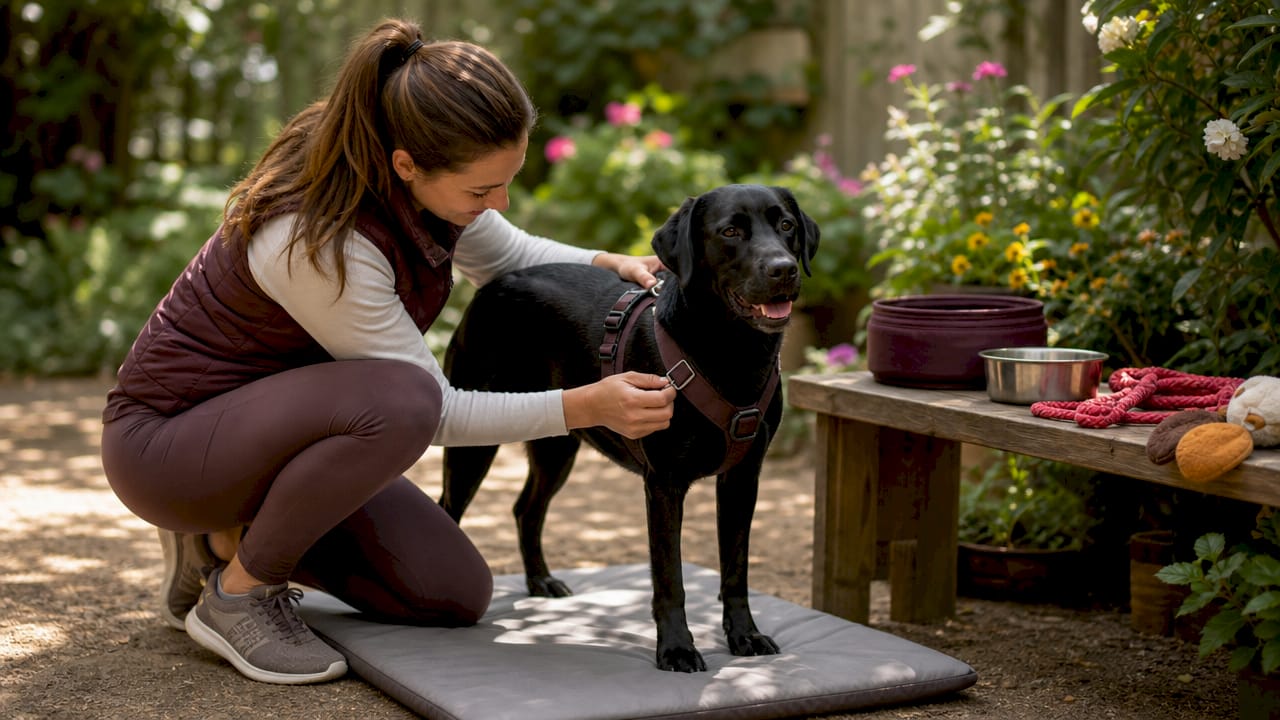
The gold standard for strap tightness is the two-finger rule. Slide two fingers under any strap. If they slide in snugly but do not require force, the fit is correct. If you can fit three or four fingers, the harness is too loose and escape risk increases. If you cannot fit two fingers, the harness is too tight and may restrict breathing or shoulder movement.
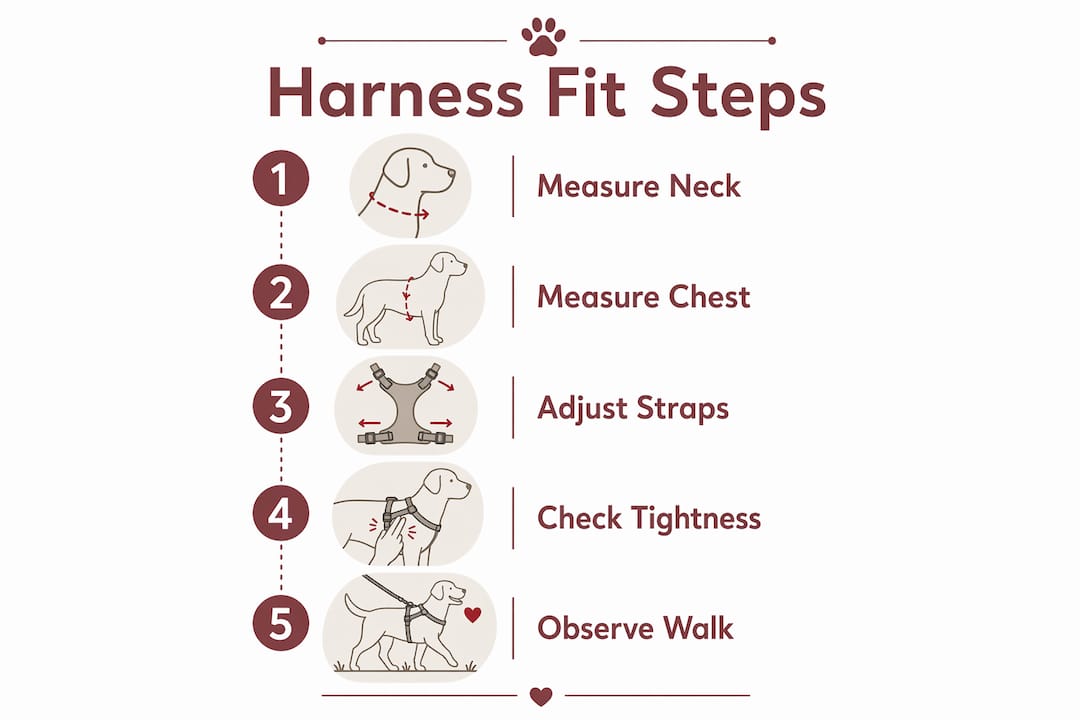
Symmetry matters as much as tightness. Centering the chest hardware on the breastbone and adjusting both sides of the harness equally prevents twisting, which causes uneven pressure and increases the chance of a dog slipping free. Always check that the D-ring sits centered on the chest or back, not pulled to one side.
| Fit check | What to look for | Action if wrong |
|---|---|---|
| Neck strap | Two fingers fit snugly | Loosen or tighten slider |
| Chest strap | Centered on breastbone | Re-adjust both sides equally |
| Belly strap (if present) | Snug but not compressing ribs | Adjust to flat contact |
| D-ring position | Centered on chest or back | Re-thread strap through hardware |
| Overall movement | Dog walks freely without chafing | Check padding contact points |
Pro Tip: After every adjustment, watch your dog walk for 30 seconds before heading out. A harness that looks correct while standing can shift or bunch once the dog is in motion, especially on vest-style models.
For detailed guidance on avoiding common fitting errors, the safe harness fit guide at Americanbarkbliss covers the most frequent mistakes owners make.
Which types of adjustable harnesses should you consider?
Not every adjustable harness suits every dog. The style you choose should match your dog’s size, energy level, and the activity you have in mind.
Front-clip harnesses attach the leash at the chest. Front-clip designs redirect a dog’s forward momentum sideways, steering their attention back toward the owner. They work best for pullers and dogs in early leash training. The PetSafe Easy Walk is the most widely referenced example in this category.
Back-clip harnesses attach at the spine. They are easier to put on and better suited for calm dogs or low-intensity activities like casual neighborhood walks. They offer less pulling control but more freedom of movement.
Vest-style harnesses wrap around the torso with a broad panel of mesh or neoprene. Breathable mesh and fleece lining reduce skin chafing and improve comfort during longer outings. These work well for small breeds and dogs with sensitive skin.
Three-point harnesses add a belly strap to the standard neck and chest configuration. For high-energy dogs or narrow-waisted breeds like Greyhounds and Whippets, a three-point harness with a belly strap is the only reliable way to prevent escape.
| Harness type | Best for | Main limitation |
|---|---|---|
| Front-clip | Pullers, leash training | Requires correct chest positioning |
| Back-clip | Calm dogs, casual walks | Minimal pulling control |
| Vest-style | Small breeds, sensitive skin | Less adjustability on some models |
| Three-point | Escape artists, narrow-waisted dogs | More complex to put on |
The Tru Fit Smart Dog Walking Harness at Americanbarkbliss is a practical example of a multi-point adjustable harness with reflective wear and a seat belt loop, covering both walk safety and car travel.
How to care for your harness to keep it safe and functional
A harness that looks fine on the outside can have compromised hardware or weakened stitching that fails under pressure. Regular inspection and cleaning are not optional maintenance tasks. They are safety practices.
Cleaning recommendations by material:
- Nylon harnesses: Hand wash in warm water with mild soap, rinse thoroughly, and air dry flat. Machine washing degrades buckle integrity over time.
- Mesh harnesses: Gentle machine wash in a laundry bag on a cold, delicate cycle. Avoid high heat drying, which warps plastic hardware.
- Fleece-lined harnesses: Spot clean the lining with a damp cloth. Full submersion can cause the fleece to mat and lose its cushioning.
Inspect the harness before every walk. Check stitching at stress points around the D-ring and buckles. Look for fraying, cracking plastic, or bent metal hardware. A buckle that does not click firmly closed is a buckle that should not be trusted on a reactive dog near traffic.
Re-adjust the harness whenever your dog’s coat changes significantly. A dog in a thick winter coat may need a full size of extra strap length compared to their summer configuration. Adjustability is a welfare necessity precisely because body shape fluctuates year-round, not just during puppyhood.
Pro Tip: Store the harness hanging on a hook rather than stuffed in a bag. Compression over time causes straps to hold a bent shape, which makes symmetrical adjustment harder and can stress the buckle attachment points.
Key takeaways
A properly fitted adjustable pet harness is the single most effective tool for combining walk safety, leash control, and long-term cost efficiency for dog owners at any stage of their dog’s life.
| Point | Details |
|---|---|
| Adjustability is a safety feature | Multi-point adjustment prevents escape and distributes leash pressure away from the trachea. |
| The two-finger rule is non-negotiable | Two fingers under any strap confirms the harness is neither too tight nor too loose. |
| Harness type must match the dog | Front-clip suits pullers; three-point suits escape-prone or narrow-waisted breeds. |
| Fit changes with coat and growth | Re-check and re-adjust seasonally and weekly for puppies under six months. |
| Damaged harnesses are unsafe harnesses | Inspect buckles and stitching before every walk and replace at the first sign of wear. |
Why I think most dog owners underestimate harness fit
I have seen a lot of dogs walking in harnesses that technically fit but are functionally wrong. The chest strap is riding up into the armpit. The D-ring is pulled three inches to the left. The belly strap is so loose it flaps. The owner has no idea because the dog is not visibly distressed. But that dog is working harder than it should on every walk, and the owner is getting less control than the harness is capable of delivering.
The biggest mistake I see is treating harness adjustment as a one-time setup task. You buy the harness, you adjust it once, and you assume it stays correct. It does not. Dogs gain weight in winter, lose it in summer, grow a thicker coat, recover from illness, and change muscle mass with exercise. Over-tightening an adjustable harness restricts shoulder movement just as surely as under-tightening creates escape risk. Both failures come from not checking the fit regularly.
My honest recommendation is to build a 30-second harness check into your pre-walk routine the same way you check your dog’s paws in winter. Run two fingers under each strap, confirm the hardware is centered, and look at the dog move for a few steps before you leave the yard. That habit costs you nothing and prevents the most common harness-related problems I see dog owners deal with. Quality adjustable gear from a trusted source, combined with consistent fit checks, is what responsible dog ownership actually looks like in practice.
— Christopher
Find the right adjustable harness at Americanbarkbliss
Americanbarkbliss carries a curated selection of adjustable harnesses and walking accessories built for dogs of all sizes and energy levels. Every product in the lineup reflects the brand’s commitment to American-made quality, durable hardware, and materials that hold up to daily use.
Whether you need a front-clip no-pull harness for a strong puller, a vest-style option for a small breed, or a three-point escape-proof design for a Greyhound, the adjustable harnesses and accessories at Americanbarkbliss are worth exploring. Pair your harness with an adjustable dog leash for a complete walking setup that gives you control without compromising your dog’s comfort.
FAQ
What is an adjustable pet harness?
An adjustable pet harness is a body-worn walking device with multiple strap adjustment points at the neck, chest, and belly, allowing owners to customize the fit for different dog sizes and body shapes. It distributes leash pressure across the torso rather than the throat, improving both safety and comfort.
How do I know if my dog’s harness fits correctly?
Use the two-finger rule: slide two fingers under any strap on the harness. If they fit snugly without forcing, the fit is correct. If the harness is too tight or too loose, adjust the relevant strap and recheck before walking.
How often should I adjust my dog’s harness?
Check the fit weekly for puppies under six months, since rapid growth can tighten a harness within days. For adult dogs, re-adjust at the start of each season to account for coat thickness and weight changes.
What is the difference between a front-clip and back-clip adjustable harness?
A front-clip harness attaches the leash at the chest and redirects a pulling dog’s momentum sideways, making it effective for leash training. A back-clip harness attaches at the spine and suits calm dogs on casual walks where pulling control is less of a priority.
Can an adjustable harness prevent my dog from escaping?
Standard two-point adjustable harnesses reduce escape risk significantly compared to collars, but dogs that are skilled at backing out of gear need a three-point harness with a belly strap for reliable security. The belly strap prevents the harness from sliding forward over the shoulders.
Leave a comment